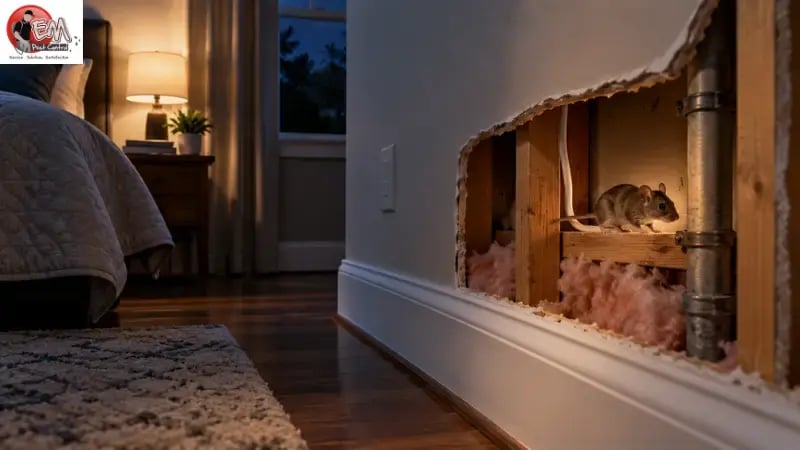
You’re lying in bed and the house is quiet when you hear it: a faint scratching or rustling coming from inside the wall. It stops, starts again a few minutes later, and now you’re wondering whether something is actually moving around in there.
Mice are one possibility, especially during the fall season on Long Island. However, scratching in a wall doesn't automatically mean mice. The time you hear it, where it seems to come from, and what you find nearby can help you work out what to check next.
What Does a Mouse in the Wall Sound Like?
Mice can make light scratching, scurrying, rustling, and gnawing sounds in a wall. You may hear a short burst, then silence, then movement again. The University of Illinois Extension describes scratching and chewing in walls or ceilings as possible signs of mice.
That doesn't mean a mouse is sitting in one spot scratching the drywall. It could be traveling through the space behind it, climbing near a pipe, chewing on material, or gathering nesting material. Those activities can sound different from one moment to the next.
Can You Tell What's in the Wall by the Sound?
Not reliably. A quick, light scurry after dark may make you suspect mice, while a heavier sound or daytime movement near the attic could point to a different animal, including a squirrel. If that sounds closer to what you're hearing, our Nassau County attic guide covers squirrels in more detail.
When we're investigating possible mice, we compare the sound with physical evidence around the area where you're hearing it. If the noise seems to be coming from a kitchen wall, for example, check accessible areas nearby for:
Fresh droppings beneath the sink, along baseboards, or inside lower cabinets
Gnawed food packaging in cabinets, pantries, or nearby storage areas
Shredded material that could be used for nesting
Activity behind or beside appliances, especially where the wall meets the floor
Gaps around pipes or utility lines that could provide a route through the structure
Signs in the basement below, particularly beneath the part of the room where you're hearing activity
Don't assume the opening mice are using will be directly behind the spot where the scratching sounds loudest. They can move through concealed spaces, so where you hear them and where they're getting into the house can be two different places.
The more the sound lines up with fresh evidence nearby, the stronger the case becomes that mice are responsible. Our guide to the signs of rodent activity explains what droppings, gnaw marks, and other clues can tell you.
Why Do You Hear Scratching More at Night?
There are two reasons a mouse may seem louder at night. Mice commonly forage after dark, when the house is less busy. And at night, you can hear things that daytime noise covers up.
During the day, an air conditioner, television, dishwasher, footsteps, or traffic may mask a faint movement behind the wall. At 1 a.m., the same movement can sound startlingly close. If the sound seems to move from the wall toward the ceiling, make note of that too. Mice can climb through concealed spaces, and the loudest point isn't necessarily the place they entered.
Why Might Scratching Start in the Fall?
Fall can change what mice find around a Long Island home before the first freeze. Nights cool, vegetation changes, and outdoor food or cover may shift. Meanwhile, a garage or wall void remains sheltered. If there is an accessible opening, mice can use it while moving between food and cover.
Mice aren't waiting for a date on the calendar. You might notice activity in September, October, or another time entirely, depending on the property and the openings available. Hearing something now is a reason to check what's happening, not proof that a seasonal mouse invasion has begun.
What Should You Do After Hearing Scratching in the Wall?
First, note the room, approximate time, and whether the sound seems to move. Then inspect accessible areas adjoining that wall for droppings, chewed food packaging, or disturbed materials. A photo or short recording can help you describe what you found. Don't tear open a wall or put products into a wall cavity based on a noise.
If you find droppings, keep children and pets away while you deal with the area. Don't sweep or vacuum them dry: the CDC's cleanup guidance explains how to wet them with disinfectant and remove them safely. If there's substantial contamination, get professional advice about cleanup.
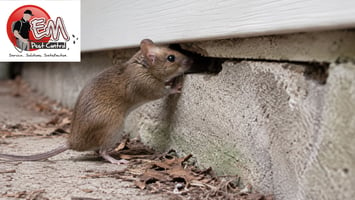
If the evidence points to mice, the next question is how they're getting into the house. Our guide to rodent entry points in Hempsteadshows openings we check around doors, foundations, vents, and utilities. If activity is ongoing, both the mice already inside and the openings they're using need to be considered. Sealing one visible gap doesn't necessarily address the entire problem.
What If You Catch a Mouse but the Scratching Comes Back?
Catching one mouse doesn't necessarily mean the activity is over. Another mouse could still be inside, especially if you're continuing to hear scratching or finding fresh droppings. It's also possible that the opening mice are using to get inside is still accessible, allowing new activity to continue.
This is why trapping and figuring out how mice are getting into the houseare two different parts of the problem. Removing the mouse you caught addresses that animal, but it doesn't tell you whether others are present or whether the same route can be used again. Our article on why mice keep returning after traps are removedtakes a closer look at why this happens and what needs to be considered when activity keeps returning.
The Bottom Line on Scratching in Your Walls at Night
Hearing scratching inside a wall at night can make it easy to assume you have mice, but the sound is only one clue. Where you hear it, when it happens, and whether you find droppings, gnawing, or other activity nearby can help build a clearer picture of what's going on.
When we're inspecting Nassau County homes for possible mouse activity, we're looking beyond the noise. We want to know where the activity is happening, how mice may be moving through the structure, and where they could be getting inside. That's why our mouse and rat control service starts with an inspection rather than making assumptions based on one sign.
If that scratching keeps coming back—or you start finding other signs around the house—don't worry about figuring everything out yourself. We can inspect the property, determine whether mice are actually responsible, and show you what needs to be addressed.

.png?height=200&name=why-do-i-keep-finding-dead-mice-in-my-house%20(1).png)
%20(1).png?height=200&name=exterm%20(1200%20x%20628%20px)%20(1).png)