---
title: Carpenter Bee Exterminators Near Me Long Island | EM Pest Control
description: Seeing carpenter bees around your roofline or trim? We treat active nesting sites and help protect exposed wood across Long Island. Get a Free quote today.
image: https://empestcontrol.com/hubfs/bee%20(500%20x%20500%20px)%20(1920%20x%201080%20px)%20(1200%20x%20628%20px)%20(1).png
---
[Skip to content](https://empestcontrol.com/carpenter-bee-control#main-content)
## Proudly Serving Nassau County & Western Suffolk
[](https://empestcontrol.com/)
- Pest Control
Show submenu for Pest Control
- [Ant Control](https://empestcontrol.com/pest-control-ants)
- [Bed Bug Control](https://empestcontrol.com/bedbug-exterminators)
Show submenu for Bed Bug Control
- [Active Guard Mattress Liner](https://empestcontrol.com/activeguard-bed-bug-liners)
- [Rodent Control](https://empestcontrol.com/rodent-exterminators)
- [Cockroach Control](https://empestcontrol.com/cockroach-exterminators)
- [Termite Control](https://empestcontrol.com/termite-control)
Show submenu for Termite Control
- [Termite Inspection](https://empestcontrol.com/termite-inspection)
- [Trelona Bait Stations](https://empestcontrol.com/trelona-termite-bait-stations)
- [Cricket Control](https://empestcontrol.com/cricket-pest-control)
- [Mosquito Control](https://empestcontrol.com/mosquito-services)
- [Wasp Control](https://empestcontrol.com/wasp-control-service)
- [Carpenter Bee Control](https://empestcontrol.com/carpenter-bee-control)
- [View All](https://empestcontrol.com/pest-library)
- Property Services
Show submenu for Property Services
- [Residential Services](https://empestcontrol.com/home-pest-control)
- [Commercial Services](https://empestcontrol.com/commercial-pest-control)
- Where We Service
Show submenu for Where We Service
- [Nassau County, NY](https://empestcontrol.com/nassau-county-pest-control)
- [Western Suffolk County](https://empestcontrol.com/suffolk-county-pest-control)
- About Us
Show submenu for About Us
- [About E.M](https://empestcontrol.com/about-us)
- [Our Blog](https://empestcontrol.com/blog)
Open main navigation
Close main navigation
- Pest Control
Show submenu for Pest Control
- [Ant Control](https://empestcontrol.com/pest-control-ants)
- [Bed Bug Control](https://empestcontrol.com/bedbug-exterminators)
Show submenu for Bed Bug Control
- [Active Guard Mattress Liner](https://empestcontrol.com/activeguard-bed-bug-liners)
- [Rodent Control](https://empestcontrol.com/rodent-exterminators)
- [Cockroach Control](https://empestcontrol.com/cockroach-exterminators)
- [Termite Control](https://empestcontrol.com/termite-control)
Show submenu for Termite Control
- [Termite Inspection](https://empestcontrol.com/termite-inspection)
- [Trelona Bait Stations](https://empestcontrol.com/trelona-termite-bait-stations)
- [Cricket Control](https://empestcontrol.com/cricket-pest-control)
- [Mosquito Control](https://empestcontrol.com/mosquito-services)
- [Wasp Control](https://empestcontrol.com/wasp-control-service)
- [Carpenter Bee Control](https://empestcontrol.com/carpenter-bee-control)
- [View All](https://empestcontrol.com/pest-library)
- Property Services
Show submenu for Property Services
- [Residential Services](https://empestcontrol.com/home-pest-control)
- [Commercial Services](https://empestcontrol.com/commercial-pest-control)
- Where We Service
Show submenu for Where We Service
- [Nassau County, NY](https://empestcontrol.com/nassau-county-pest-control)
- [Western Suffolk County](https://empestcontrol.com/suffolk-county-pest-control)
- About Us
Show submenu for About Us
- [About E.M](https://empestcontrol.com/about-us)
- [Our Blog](https://empestcontrol.com/blog)
- [Get A Free Quote](https://empestcontrol.com/contact-us)
[Get A Free Quote](https://empestcontrol.com/contact-us)
Serving Nassau County & Western Suffolk
[info@empestcontrol.com](mailto:info@empestcontrol.com) [Text 516-491-2768](sms:+15164912768) [Call 516-455-6742](tel:5164556742)
[](https://empestcontrol.com/)
- Pest Control
- [Ant Control](https://empestcontrol.com/pest-control-ants)
- [Bed Bug Control](https://empestcontrol.com/bedbug-exterminators)
- [ActiveGuard Mattress Liner](https://empestcontrol.com/activeguard-bed-bug-liners)
- [Rodent Control](https://empestcontrol.com/rodent-exterminators)
- [Cockroach Control](https://empestcontrol.com/cockroach-exterminators)
- [Termite Control](https://empestcontrol.com/termite-control)
- [Termite Inspection](https://empestcontrol.com/termite-inspection)
- [Trelona Bait Stations](https://empestcontrol.com/trelona-termite-bait-stations)
- [Cricket Control](https://empestcontrol.com/cricket-pest-control)
- [Mosquito Control](https://empestcontrol.com/mosquito-services)
- [In2Care Mosquito Station](https://empestcontrol.com/in2care-mosquito-station)
- [Wasp Control](https://empestcontrol.com/wasp-control-service)
- [Carpenter Bee Control](https://empestcontrol.com/carpenter-bee-control)
- [View All](https://empestcontrol.com/pest-library)
- Property Services
- [Residential Services](https://empestcontrol.com/home-pest-control)
- [Commercial Pest Control](https://empestcontrol.com/commercial-pest-control)
- [Hotel & Hospitality Pest Control](https://empestcontrol.com/commercial/hospitality-pest-control)
- [Restaurant & Commercial Kitchen Pest Control](https://empestcontrol.com/commercial/restaurant-pest-control)
- [Multifamily Pest Control](https://empestcontrol.com/commercial/multifamily-pest-control)
- Service Areas
- [Nassau County](https://empestcontrol.com/nassau-county-pest-control)
- [Western Suffolk](https://empestcontrol.com/suffolk-county-pest-control)
- [Blog](https://empestcontrol.com/blog)
- [Reviews](https://empestcontrol.com/customer-reviews)
- [About Us](https://empestcontrol.com/about-us)
[Get a Free Quote](https://empestcontrol.com/contact-us)
[](https://empestcontrol.com/)
- Pest Control
- [Ant Control](https://empestcontrol.com/pest-control-ants)
- Bed Bug Control
- [Bed Bug Control](https://empestcontrol.com/bedbug-exterminators)
- [ActiveGuard Mattress Liner](https://empestcontrol.com/activeguard-bed-bug-liners)
- [Rodent Control](https://empestcontrol.com/rodent-exterminators)
- [Cockroach Control](https://empestcontrol.com/cockroach-exterminators)
- Termite Control
- [Termite Control](https://empestcontrol.com/termite-control)
- [Termite Inspection](https://empestcontrol.com/termite-inspection)
- [Trelona Bait Stations](https://empestcontrol.com/trelona-termite-bait-stations)
- [Cricket Control](https://empestcontrol.com/cricket-pest-control)
- Mosquito Control
- [Mosquito Control](https://empestcontrol.com/mosquito-services)
- [In2Care Mosquito Station](https://empestcontrol.com/in2care-mosquito-station)
- [Wasp Control](https://empestcontrol.com/wasp-control-service)
- [Carpenter Bee Control](https://empestcontrol.com/carpenter-bee-control)
- [View All](https://empestcontrol.com/pest-library)
- Property Services
- [Residential Services](https://empestcontrol.com/home-pest-control)
- Commercial Pest Control
- [Commercial Pest Control](https://empestcontrol.com/commercial-pest-control)
- [Hotel & Hospitality Pest Control](https://empestcontrol.com/commercial/hospitality-pest-control)
- [Restaurant Pest Control](https://empestcontrol.com/commercial/restaurant-pest-control)
- [Multifamily Pest Control](https://empestcontrol.com/commercial/multifamily-pest-control)
- Service Areas
- [Nassau County](https://empestcontrol.com/nassau-county-pest-control)
- [Western Suffolk](https://empestcontrol.com/suffolk-county-pest-control)
- [Blog](https://empestcontrol.com/blog)
- [Reviews](https://empestcontrol.com/customer-reviews)
- [About Us](https://empestcontrol.com/about-us)
[Get a Free Quote](https://empestcontrol.com/contact-us) [Call 516-455-6742](tel:5164556742) [Text 516-491-2768](sms:+15164912768) [info@empestcontrol.com](mailto:info@empestcontrol.com)
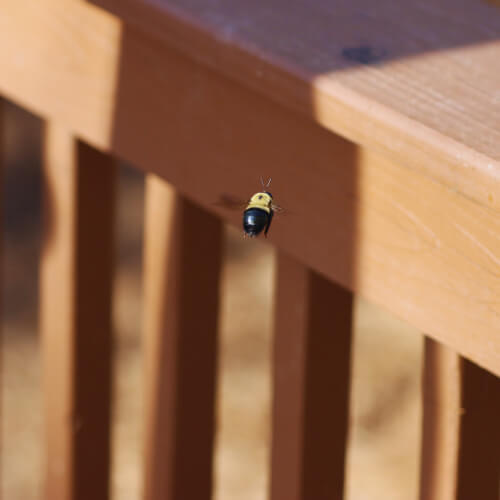
# **Carpenter Bee Treatment & Control on Long Island**
[Schedule an Inspection](https://empestcontrol.com/carpenter-bee-control#service)
## Your Local Carpenter Bee Control Experts
### **Serving Nassau County | Western Suffolk County**
Do you see perfectly round holes in your wood or large bees hovering around your deck or roofline?
Carpenter bees don’t behave like honeybees and bumble bees—they bore into wood and often return to the same areas year after year. At EM Pest Control, we provide **professional carpenter bee treatment, control, and prevention** designed to stop current activity and protect your home from repeat damage.
If you’re dealing with carpenter bee holes in your deck, siding, or trim—or searching for a "**carpenter bee exterminator near me"**—our inspection-first approach is designed to solve the problem and help prevent it from coming back.
[Call: (516) 455-6742](tel:5164556742)
KNOW MORE
[Text: (516) 491-2768](tel:5164912768)
KNOW MORE
## Risks & Signs of a Carpenter Bee Infestation
The primary concern with carpenter bees is **ongoing wood damage**, not stinging. Over time, repeated tunneling can weaken decks, fascia boards, trim, and other exterior wood. Untreated galleries may also attract woodpeckers, causing additional damage as they try to reach larvae inside the wood.
Homeowners often notice activity in spring, especially around decks, siding, and entryways. Addressing carpenter bee activity early helps limit damage and reduce long-term problems.
### Common signs we see during inspections include:
- Perfectly round holes in wood (about ½ inch in diameter)
- Coarse sawdust (frass) beneath decks, railings, siding, or trim
- Large bees hovering near wood surfaces
- Repeat activity in the same areas year after year
## **Why Carpenter Bees Keep Coming Back**
Carpenter bees are drawn to **exposed or weathered wood** and often return to the same locations year after year. Once tunnels are established, they are commonly reused or expanded over time.
This type of activity is especially common in Nassau County towns like Hicksville, Levittown, and Garden City, as well as parts of Western Suffolk where exposed wood and older decks are more common.
**During inspections, we most often find activity in:**
- **Decks & Railings** – undersides, joists, and support boards
- **Fascia & Soffits** – along rooflines and eaves
- **Cedar Siding & Trim** – window trim, door frames, cedar shake
- **Outdoor Structures** – pergolas, sheds, fences, playsets
Homes in areas like [Hicksville](https://empestcontrol.com/pest-control-in-hicksville-ny)**, Levittown, Garden City,** [Massapequa](https://empestcontrol.com/pest-control-in-massapequa-ny)**, and** [Great Neck](https://empestcontrol.com/great-neck-ny-pest-control)tend to see recurring carpenter bee activity due to older wood construction and exposed trim.
## **How do you get rid of carpenter bees?**
Getting rid of carpenter bees requires treating the active galleries inside the wood—not just the surface. Professional carpenter bee treatment targets the tunnel system, helping stop current activity and reduce the chances of bees returning to the same areas.
If you’re seeing new holes or repeat activity, we can take a look and show you exactly what’s going on.
[Request an Inspection](https://empestcontrol.com/carpenter-bee-control#service)
## **Carpenter Bee Control on Long Island – What to Expect**
- Detailed inspection of affected wood areas
- Treatment of active carpenter bee galleries
- Preventative applications to reduce future nesting
- Recommendations to protect decks, siding, trim, and structures
## Our Carpenter Bee Control Approach
Our carpenter bee treatment and prevention service is designed to stop current activity and reduce the chances of it returning.
We begin with a focused inspection of affected and vulnerable areas, especially where repeat activity is common.
From there, we:
- Treat active carpenter bee galleries to stop tunneling
- Address areas of repeated activity
- Apply preventative treatments to reduce future nesting
- Provide clear recommendations to help protect your wood over time
This allows us to provide effective carpenter bee pest control without relying on temporary fixes.
%20(1920%20x%20700%20px)%20(600%20x%20400%20px).jpg "Eric servicing for bees and wasps")
## **How We Help Prevent Carpenter Bees from Returning**
Treating active galleries is only part of the solution.
We also focus on long-term carpenter bee prevention by:
- Identifying wood conditions that attract nesting
- Recommending sealing, painting, or protecting exposed wood
- Addressing repeat problem areas
- Helping you stay ahead of future activity
Carpenter bee damage doesn’t fix itself—and the longer galleries are reused, the worse it can get. Early treatment makes a noticeable difference.
## Why Choose EM Pest Control?
### Family-Owned in Uniondale
We’ve served Long Island homes and businesses for more than 10 years. You’re working with a local family whose name stands behind the service.
### Licensed & Insured
EM Pest Control is licensed and insured, so you have those credentials to check when choosing who to bring into your home or business.
### We Inspect Before We Treat
We identify the pest, where it’s active, and what’s supporting the problem. Those findings guide the treatment we recommend for your property.
### No Long-Term Contracts
We offer monthly, every-other-month, and quarterly service based on your property’s needs. There’s no annual commitment, and you can cancel anytime.
### Support Between Scheduled Visits
You don’t have to wait until your next appointment to tell us something’s wrong. If a covered pest problem comes up, let us know what you’re seeing and where—we’ll return to address it.
### Service for Homes & Businesses
We service homes, restaurants, warehouses, hotels, and multifamily properties. We understand that each setting brings different concerns, and we build service around how your property is used.
### BBB Accredited & an NPMA Member
EM Pest Control is a BBB Accredited Business and a member of the National Pest Management Association. Both are part of the professional background you can review before choosing our team.
### Your Property Matters to Us
You’re inviting us into a place you care about. We take that responsibility seriously.
#### Respect for Your Space
We discuss access and preparation with you and work carefully around your belongings and daily operations.
#### Time for Your Questions
If something about the service is unclear, ask us. We want you to feel comfortable with the work being done.
[Schedule an Inspection](https://empestcontrol.com/contact-us)
## See What Long Island Homeowners Are Saying
[See More Verified Reviews on Google](https://g.page/r/CaREF1Ge5UE1EBE/review)
Verified Google Review
*“I had a great experience with EM Pest Control. Devin was professional, thorough, and addressed both a small ant issue and carpenter bee activity during our maintenance visit. He explained everything clearly and was a pleasure to work with. Highly recommend!”*
Wendy W.
Hicksville, NY
Verified Google Review
*“Knowledgeable, thorough, and effective. Their staff is professional, efficient, and educates customers to help get the best results.”*
Arelethia L.
Nassau County, NY
## Carpenter Bee Exterminators In Your Area
EM Pest Control provides carpenter bee treatment and prevention services across Nassau County and parts of Western Suffolk County, including Amityville, Huntington, Babylon and Lindenhurst, helping homeowners and businesses protect decks, trim, fascia boards, soffits, and other exposed wood from repeat activity.
If you’re searching for a **carpenter bee exterminator near me on Long Island**, our team provides targeted treatment and prevention based on the wood conditions, activity level, and areas affected around your property.
### Serving:
- [Hempstead, NY](https://empestcontrol.com/hempstead-ny-pest-control-service)
- [Uniondale, NY](https://empestcontrol.com/uniondale-ny-pest-control)
- [Westbury, NY](https://empestcontrol.com/westbury-ny-pest-control)
- [Rockville Centre, NY](https://empestcontrol.com/pest-control-rockville-centre)
- [Hicksville, NY](https://empestcontrol.com/pest-control-in-hicksville-ny)
- [Massapequa, NY](https://empestcontrol.com/pest-control-in-massapequa-ny)
- [Baldwin, NY](https://empestcontrol.com/pest-control-in-baldwin-ny)
- [Freeport, NY](https://empestcontrol.com/pest-control-in-freeport-ny)
- [Roosevelt, NY](https://empestcontrol.com/pest-control-in-roosevelt-ny)
- [Great Neck, NY](https://empestcontrol.com/great-neck-ny-pest-control)
- [Kings Point, NY](https://empestcontrol.com/kings-point-ny-pest-control)
- [Levittown, NY](https://empestcontrol.com/levittown-ny-pest-control)
## Frequently Asked Questions
### Why are your services more effective than DIY attempts?
DIY carpenter bee treatments often only reach the surface and fail to eliminate eggs deep inside the wood galleries. Our professional carpenter bee service targets the entire tunnel system, helping stop current activity and reduce the chances of it returning.
### Are your services safe for my family and pets?
Yes. Our carpenter bee treatments are applied directly to affected areas using targeted methods designed to minimize exposure. Before service, we review any necessary precautions to ensure safety for your household and pets.
### Can I just plug the holes myself?
Plugging carpenter bee holes without properly treating the galleries can trap activity inside the wood or lead to new tunneling nearby. Effective carpenter bee control involves treating the galleries first, then sealing them to help prevent future problems.
### What should I do if I notice carpenter bee holes?
If you notice carpenter bee holes, avoid sealing them right away. Closing an active gallery can force bees to create new exit holes, causing additional damage. The best first step is a professional carpenter bee inspection.
### What's the best time to treat for bees?
Evening treatments are often most effective when bees are coming back from foraging and less active.
### What’s the best time to treat for carpenter bees?
The best time for carpenter bee treatment is typically in spring when activity begins, but treatment can be effective anytime you see active holes. Evening applications are often most effective when bees are inside the galleries.
### Do carpenter bees come back every year?
Yes. Carpenter bees often return to the same wood areas year after year, especially if galleries are not properly treated and sealed. This is why prevention plays an important role in long-term control.
### How much does carpenter bee removal cost on Long Island?
Pricing depends on the extent of activity and the areas affected. We provide free inspections so you know exactly what’s going on and what it will take to fix—before any work begins.
## **Schedule Your Carpenter Bee Service**
If you’re seeing carpenter bees around your roofline, trim, or deck, we’ll inspect the activity and recommend the right treatment for your home.
## Professional Credentials & Affiliations
[](https://empestcontrol.com)
[](https://empestcontrol.com)
[](https://www.bbb.org/us/ny/uniondale/profile/pest-control-services/em-pest-control-inc-0121-162929/#sealclick)
[](https://empestcontrol.com)
**Uniondale, NY**
[516-455-6742](tel:5164556742)
[516-491-2768](tel:5164912768)
[Info@empestcontrol.com](mailto:info@empestcontrol.com)
## **Hours of Operation**
Hours
M-F: 8:00am - 6:00pm
Sat: 8:00am - 3:00pm
Sun: Closed
[ Text](sms:+15164912768) [ Call Now](tel:+15164556742) [ Free Quote](https://empestcontrol.com/contact-us)
## Links
[About Us](https://empestcontrol.com/about-us)
[Residential Pest Control](https://empestcontrol.com/home-pest-control)
[Commercial Pest Control](https://empestcontrol.com/commercial-pest-control)
[Pest Services](https://empestcontrol.com/pest-library)
[Blog](https://empestcontrol.com/blog)
[Where We Service](https://empestcontrol.com/where-we-service)
[Contact Us](https://empestcontrol.com/contact-us)
[facebook-f icon](https://www.facebook.com/EMPestControlNY/) [Follow us on Instagram](https://www.instagram.com/empestcontrolinc/) [Follow us on X (Twiiter)](https://x.com/empestcontrol14) [Follow us on Facebook](https://www.google.com/search?q=em+pest+control&sca_esv=f517df8b24517ced&sxsrf=AE3TifPZ6UoI7b9Hf1aJ9xQcS-tuyV324g%3A1763152832953&source=hp&ei=wJMXaaPMN46Ep84P786AoA8&iflsig=AOw8s4IAAAAAaReh0K_Vg373CG2rmjCBUWxXalFqeD8A&oq=em+&gs_lp=Egdnd3Mtd2l6IgNlbSAqAggAMgoQABiABBhDGIoFMgoQABiABBhDGIoFMgsQABiABBixAxiDATIREC4YgAQYkQIYxwEYigUYrwEyEBAuGIAEGEMYxwEYigUYrwEyCxAAGIAEGLEDGIMBMg4QLhiABBjHARiOBRivATIFEAAYgAQyBRAAGIAEMgUQABiABEiMHlAAWP4RcAB4AJABAJgBmQGgAfQCqgEDMC4zuAEDyAEA-AEBmAIDoAKFA8ICChAjGIAEGCcYigXCAgsQABiABBiRAhiKBcICERAuGIAEGLEDGNEDGIMBGMcBwgIIEC4YgAQYsQPCAgQQABgDwgILEC4YgAQYsQMYgwHCAhAQLhiABBjRAxhDGMcBGIoFwgIREC4YgAQYsQMYxwEYjgUYrwGYAwCSBwMwLjOgB-QnsgcDMC4zuAeFA8IHBzAuMi4wLjHIBww&sclient=gws-wiz)
© 2026 EM Pest Control. All rights reserved. [Privacy Policy](https://empestcontrol.com/privacy-policy)
```json
{
"@context" : "https://schema.org",
"@type" : "FAQPage",
"mainEntity" : [ {
"@type" : "Question",
"acceptedAnswer" : {
"@type" : "Answer",
"text" : "DIY carpenter bee treatments often only reach the surface and fail to eliminate eggs deep inside the wood galleries. Our professional carpenter bee service targets the entire tunnel system, helping stop current activity and reduce the chances of it returning."
},
"name" : "Why are your services more effective than DIY attempts?"
}, {
"@type" : "Question",
"acceptedAnswer" : {
"@type" : "Answer",
"text" : "Yes. Our carpenter bee treatments are applied directly to affected areas using targeted methods designed to minimize exposure. Before service, we review any necessary precautions to ensure safety for your household and pets."
},
"name" : "Are your services safe for my family and pets?"
}, {
"@type" : "Question",
"acceptedAnswer" : {
"@type" : "Answer",
"text" : "Plugging carpenter bee holes without properly treating the galleries can trap activity inside the wood or lead to new tunneling nearby. Effective carpenter bee control involves treating the galleries first, then sealing them to help prevent future problems."
},
"name" : "Can I just plug the holes myself?"
}, {
"@type" : "Question",
"acceptedAnswer" : {
"@type" : "Answer",
"text" : "If you notice carpenter bee holes, avoid sealing them right away. Closing an active gallery can force bees to create new exit holes, causing additional damage. The best first step is a professional carpenter bee inspection."
},
"name" : "What should I do if I notice carpenter bee holes?"
}, {
"@type" : "Question",
"acceptedAnswer" : {
"@type" : "Answer",
"text" : "Evening treatments are often most effective when bees are coming back from foraging and less active."
},
"name" : "What's the best time to treat for bees?"
}, {
"@type" : "Question",
"acceptedAnswer" : {
"@type" : "Answer",
"text" : "The best time for carpenter bee treatment is typically in spring when activity begins, but treatment can be effective anytime you see active holes. Evening applications are often most effective when bees are inside the galleries."
},
"name" : "What’s the best time to treat for carpenter bees?"
}, {
"@type" : "Question",
"acceptedAnswer" : {
"@type" : "Answer",
"text" : "Yes. Carpenter bees often return to the same wood areas year after year, especially if galleries are not properly treated and sealed. This is why prevention plays an important role in long-term control."
},
"name" : "Do carpenter bees come back every year?"
}, {
"@type" : "Question",
"acceptedAnswer" : {
"@type" : "Answer",
"text" : "Pricing depends on the extent of activity and the areas affected. We provide free inspections so you know exactly what’s going on and what it will take to fix—before any work begins."
},
"name" : "How much does carpenter bee removal cost on Long Island?"
} ]
}
```
```json
{
"@context" : "https://schema.org",
"@id" : "https://empestcontrol.com/#localbusiness",
"@type" : "LocalBusiness",
"address" : {
"@type" : "PostalAddress",
"addressCountry" : "US",
"addressLocality" : "Uniondale",
"addressRegion" : "NY",
"postalCode" : "11553"
},
"areaServed" : [ {
"@type" : "AdministrativeArea",
"name" : "Nassau County"
}, {
"@type" : "AdministrativeArea",
"name" : "Suffolk County"
}, {
"@type" : "City",
"name" : "Uniondale"
}, {
"@type" : "City",
"name" : "Hempstead"
}, {
"@type" : "City",
"name" : "Hicksville"
}, {
"@type" : "City",
"name" : "Roosevelt"
}, {
"@type" : "City",
"name" : "Westbury"
}, {
"@type" : "City",
"name" : "Massapequa"
}, {
"@type" : "City",
"name" : "Great Neck"
} ],
"contactPoint" : [ {
"@type" : "ContactPoint",
"contactType" : "customer service",
"telephone" : "+1-516-455-6742"
}, {
"@type" : "ContactPoint",
"contactType" : "customer service",
"telephone" : "+1-516-491-2768"
} ],
"description" : "EM Pest Control provides residential and commercial pest control services across Nassau County and Western Suffolk County, NY.",
"geo" : {
"@type" : "GeoCoordinates",
"latitude" : 40.7004,
"longitude" : -73.5929
},
"image" : "https://24346741.fs1.hubspotusercontent-na1.net/hubfs/24346741/EM%20Pest%20Control%20Service%20Truck.webp",
"logo" : "https://24346741.fs1.hubspotusercontent-na1.net/hubfs/24346741/new%20logo.png",
"name" : "EM Pest Control Inc",
"openingHoursSpecification" : [ {
"@type" : "OpeningHoursSpecification",
"closes" : "18:00",
"dayOfWeek" : [ "Monday", "Tuesday", "Wednesday", "Thursday", "Friday" ],
"opens" : "08:00"
}, {
"@type" : "OpeningHoursSpecification",
"closes" : "15:00",
"dayOfWeek" : "Saturday",
"opens" : "08:00"
} ],
"priceRange" : "$$",
"sameAs" : [ "https://maps.app.goo.gl/7oofBFXJMcQxjnLP9", "https://www.yelp.com/biz/em-pest-control-uniondale-3", "https://www.bbb.org/us/ny/uniondale/profile/pest-control/em-pest-control-inc-0121-162929", "https://x.com/empestcontrol14", "https://www.facebook.com/EMPestControlNY", "https://www.instagram.com/empestcontrolinc" ],
"telephone" : "+1-516-455-6742",
"url" : "https://empestcontrol.com/"
}
```
```json
{
"@context" : "https://schema.org",
"@id" : "https://empestcontrol.com/carpenter-bee-control#service",
"@type" : "Service",
"areaServed" : [ {
"@type" : "AdministrativeArea",
"name" : "Nassau County"
} ],
"description" : "Carpenter bee removal and prevention with targeted treatment and entry-hole sealing to help reduce repeat activity and wood damage.",
"hasOfferCatalog" : {
"@type" : "OfferCatalog",
"itemListElement" : [ {
"@type" : "Offer",
"itemOffered" : {
"@type" : "Service",
"name" : "Carpenter Bee Removal"
}
}, {
"@type" : "Offer",
"itemOffered" : {
"@type" : "Service",
"name" : "Entry-Hole Sealing & Prevention"
}
} ],
"name" : "Carpenter Bee Control Solutions"
},
"mainEntityOfPage" : {
"@id" : "https://empestcontrol.com/carpenter-bee-control#webpage",
"@type" : "WebPage",
"url" : "https://empestcontrol.com/carpenter-bee-control"
},
"name" : "Carpenter Bee Control",
"provider" : {
"@id" : "https://empestcontrol.com/#localbusiness"
},
"serviceType" : "Carpenter Bee Removal & Prevention",
"url" : "https://empestcontrol.com/carpenter-bee-control"
}
```